
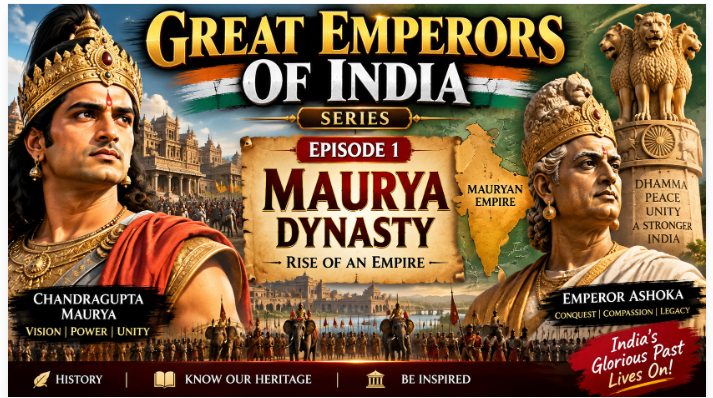
🇮🇳 Great Emperors of India – Episode 1: The Maurya Dynasty
Key themes of empire
The Rise of an Empire, the Power of Vision, and the Legacy of Asoka,Maurya Dynasty
India’s history is filled with remarkable civilizations, powerful kingdoms, brilliant thinkers, courageous warriors, and extraordinary rulers. Among the greatest imperial dynasties of ancient India, the Maurya Dynasty holds a special place. The Mauryan Empire transformed the political landscape of the Indian subcontinent and produced some of the most memorable figures in Indian history.
Welcome to Episode 1 of the Great Emperors of India Series, presented by SSE Knowledge Centre. In this episode, we explore the rise of the Mauryan Empire, the achievements of Chandragupta Maurya, the wisdom associated with Chanakya, the reign of Bindusara, and the remarkable transformation of Emperor Asoka.
For more educational stories and informative content, visit SSE Knowledge Centre – sseknowledgecentre.in and follow SSE Knowledge Centre on YouTube.
🏛️ The Beginning of the Maurya Dynasty
The Maurya Empire emerged in the late fourth century BCE at a time when the Indian subcontinent was divided among numerous kingdoms and political powers.
Magadha, located in present-day Bihar, was one of the strongest political centers in northern India. Its capital, Pataliputra, was an important center of administration, trade, and political power.
It was during this period that Chandragupta Maurya rose to prominence.
Historical and literary traditions associate Chandragupta with Chanakya, also known as Kautilya. Chanakya is traditionally associated with the Arthashastra, a famous work dealing with governance, economics, diplomacy, administration, military strategy, and statecraft.
Together, Chandragupta and Chanakya are remembered as key figures in the establishment of the Mauryan Empire.
👑 Chandragupta Maurya – The Founder
Chandragupta Maurya became the founder of the Mauryan Empire and one of the most important rulers of ancient India.
He challenged the existing political order in Magadha and established Mauryan authority. From there, the empire expanded considerably.
Chandragupta’s achievement was not simply the result of military victories. Building a large empire required administration, taxation, diplomacy, communication, military organization, and political strategy.
The Mauryan state developed a centralized administrative structure with officials responsible for different areas of governance.
Pataliputra became the heart of this growing empire.
Chandragupta’s reign represents an important turning point in Indian history because large territories were brought under a powerful imperial administration.
⚔️ Expansion of the Mauryan Empire
The Mauryan Empire continued to expand under Chandragupta. Maurya Dynasty
One of the important episodes of his reign involved his conflict with Seleucus I Nicator, one of the successors of Alexander the Great. Their eventual settlement resulted in diplomatic relations between the Mauryan and Hellenistic worlds.
The Mauryan Empire became a major power across large parts of the Indian subcontinent.
Its growing network of administration, trade routes, cities, agriculture, and military organization helped connect diverse regions under imperial rule.
🧠 Chanakya and the Art of Statecraft
The story of the Mauryan Empire cannot be separated from the legendary figure of Chanakya.
Known by several names, including Kautilya and Vishnugupta in historical traditions, Chanakya is remembered as a teacher, strategist, political thinker, and adviser.
The Arthashastra discusses subjects ranging from taxation and administration to diplomacy, espionage, economics, law, agriculture, and military organization.
Whether every tradition associated with Chanakya can be historically verified is a matter of scholarly discussion, but his place in the cultural memory of Indian political thought remains extraordinary.
His association with Chandragupta has made their story one of the most famous partnerships in ancient Indian history.
👑 Bindusara – Continuing the Empire
After Chandragupta Maurya, his son Bindusara succeeded him.
Bindusara inherited a powerful empire and played an important role in maintaining and expanding Mauryan authority.
Although considerably less information about Bindusara survives compared with Chandragupta and Asoka, his reign was important in preserving the strength of the Mauryan state.
The empire remained one of the major political powers of the Indian subcontinent.
☸️ Emperor Asoka – The Great Mauryan Ruler
The most famous Mauryan emperor is undoubtedly Asoka.
Asoka inherited a vast and powerful empire. His reign is particularly significant because of the dramatic transformation traditionally associated with the Kalinga War.
Kalinga, located in eastern India, resisted Mauryan expansion. The conflict resulted in enormous suffering and loss of life.
According to Asoka’s own inscriptions, the consequences of the war deeply affected him.
After the Kalinga campaign, Asoka increasingly emphasized Dhamma, ethical conduct, compassion, tolerance, social responsibility, and peaceful coexistence.
This transformation made Asoka one of the most unusual rulers of the ancient world.
🕊️ Asoka and Dhamma
Maurya Dynasty
Asoka communicated his ideas through inscriptions carved on rocks and pillars across his empire.
These inscriptions provide important evidence about his policies and ideas.
Asoka encouraged people to practice compassion, respect parents and elders, behave responsibly, show consideration toward different religious communities, and promote social harmony.
His policies demonstrate that kingship could be presented not only as a source of military authority but also as a responsibility toward society.
Asoka also became closely associated with the spread and patronage of Buddhism.
His influence contributed to Buddhism’s expansion beyond its earlier centers, including toward regions outside the Indian subcontinent.
🦁 The Legacy of the Lion Capital
One of the most recognizable symbols connected with Asoka is the Lion Capital of Sarnath.
The four-lion capital became an important symbol of modern India and forms the basis of the State Emblem of India.
The Asoka Chakra also became an important national symbol and appears at the center of the Indian national flag.
Thus, the legacy of the Mauryan period remains visible in India even today.
🏛️ Mauryan Administration and Economy
The strength of the Mauryan Empire depended on more than its rulers.
Agriculture formed an important part of the economy, while trade connected different regions. Cities served as administrative and commercial centers.
The Mauryan state maintained a large military and employed officials to manage taxation, law, agriculture, trade, security, and other responsibilities.
Pataliputra became one of the great urban centers of the ancient Indian world.
The Mauryan administrative system demonstrates the complexity that large states had already achieved in ancient India.
📉 The Decline of the Mauryan Empire
Following Asoka’s death, the Mauryan Empire gradually weakened.
The reasons for its decline are debated by historians. Changes in central authority, political instability, regional pressures, and the challenges of maintaining a vast empire may all have contributed.
Eventually, the Mauryan Dynasty came to an end in the second century BCE.
However, the end of the dynasty did not mean the end of its influence.
🇮🇳 The Lasting Legacy of the Mauryas
The Maurya Dynasty left an extraordinary mark on Indian history.
Chandragupta Maurya is remembered for founding a powerful empire.
Chanakya became a legendary figure in Indian political thought.
Bindusara maintained the strength of the Mauryan state.
And Asoka became famous not merely for conquest but for his transformation and promotion of Dhamma.
The Mauryan period represents a significant chapter in the development of political organization, administration, diplomacy, culture, and ethical ideas in ancient India.
📚 Conclusion
The story of the Maurya Dynasty is much more than a story of kings, armies, and battles. It is a story of ambition, strategy, administration, transformation, responsibility, and legacy.
From Chandragupta’s rise to the extraordinary transformation of Asoka, the Mauryan period offers valuable lessons about leadership and the consequences of power.
Centuries later, the symbols and ideas associated with Asoka remain an important part of India’s national identity.
This is only the beginning of our journey through the Great Emperors of India Series.
👑 Great Emperors of India – Episode 1
MAURYA DYNASTY: THE RISE OF AN EMPIRE
📚 Learn History • Know Our Heritage • Be Inspired
For more educational articles and knowledge-based content, visit SSE Knowledge Centre.
▶️ YouTube: SSE Knowledge Centre — SSE Knowledge Centre YouTube Channel
SSE Knowledge Centre — Knowledge Today, Success Tomorrow. 🇮🇳📚
🔖 Hashtags
#GreatEmperorsOfIndia #MauryaDynasty #MauryanEmpire #ChandraguptaMaurya #EmperorAshoka #AshokaTheGreat #Chanakya #Kautilya #AncientIndia #IndianHistory #HistoryOfIndia #KalingaWar #IndianHeritage #SSEKnowledgeCentre #Asoka #MauryaEmpire