
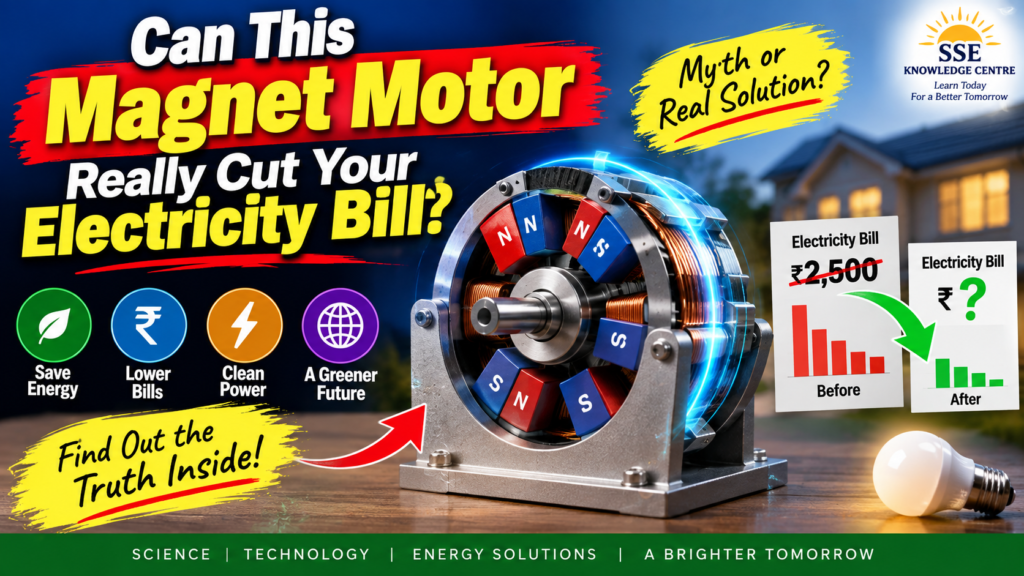
Can This Magnet Motor Really Cut Your Electricity Bill? The Truth Behind Magnetic Motors
Imagine a motor that keeps spinning with the help of magnets and produces useful mechanical power without consuming much electricity. Now imagine using that motor to reduce your monthly electricity bill dramatically. It sounds exciting—and videos of magnetic motors, “free energy machines,” and self-running generators often make the idea look surprisingly convincing.magnet motor
But can a magnet motor really cut your electricity bill?
The answer requires understanding what magnets actually do, how electric motors work, and where the energy in a supposedly “self-running” machine comes from.
What Is a Magnet Motor?
A magnet motor is generally a motor or mechanical system that uses magnetic forces to create or maintain motion. Permanent magnets can attract or repel one another, and carefully arranged magnetic fields can produce torque in a rotating system.
This principle is completely real.
In fact, magnets are already an important part of many conventional electric motors. Motors used in appliances, electric vehicles, fans, pumps, tools, and industrial machinery can use permanent magnets to improve efficiency.
The important question, however, is different:
Can permanent magnets continuously provide enough energy to run a motor and produce extra electricity without an external energy source?
This is where many online claims become misleading.
Magnets Are Not the Same as a Fuel Source
A permanent magnet has a magnetic field, and that field can exert forces on other magnetic materials. However, this does not mean a magnet continuously supplies unlimited usable energy.
Think about a magnet attracting a metal object. The object can accelerate toward the magnet and gain kinetic energy. But once the object reaches its final position, the process does not continuously produce energy.
To repeat the process, you have to reset the system.
That distinction is extremely important when evaluating so-called “free energy” magnetic motors.
A rotating arrangement of magnets may appear to have a continuous pushing or pulling action. However, over a complete cycle, the system cannot simply create unlimited net energy from permanent magnets.
Why Do Some Magnetic Motors Keep Spinning?
Some demonstrations can be particularly impressive.
A rotor may spin for a surprisingly long time after being started. Low-friction bearings, carefully balanced components, strong magnets, lightweight rotors, and favorable mechanical conditions can make the movement appear almost self-sustaining.magnet motor
But long-lasting motion is not the same thing as continuous energy production.
If the system is producing useful electrical power, mechanical resistance increases. The generator connected to the motor requires energy to turn. Electrical loads create additional resistance and losses.
This means that a system that spins freely with almost no load may behave very differently when asked to power an appliance.
What Happens When You Connect a Generator?
This is one of the most important tests.
Suppose a magnetic rotor is spinning freely. Now connect it to a generator and use the generator to power a light bulb.
The generator converts mechanical energy into electrical energy. That conversion requires torque.
As the electrical load increases, the generator becomes harder to rotate. The original motor or rotor therefore needs additional energy to maintain its speed.
This is a normal consequence of energy conservation.magnet motor
If someone claims that a magnetic motor can continuously generate electricity while simultaneously powering itself, the complete energy flow should be carefully measured.
Where does the input energy come from?
Is there a battery hidden somewhere?
Is electricity being supplied through another circuit?
Is the rotor receiving mechanical energy from an external source?
Are there measurement errors?
These questions matter far more than how impressive the machine looks.
Can It Reduce Your Electricity Bill?
A magnet motor can potentially be part of an efficient motor system, but simply using permanent magnets does not automatically mean your electricity consumption will become zero.
Modern permanent-magnet motors can be highly efficient because they can reduce certain losses and provide strong torque in a compact design.
If you replace an inefficient motor with a more efficient motor, you may reduce electricity consumption.
For example, an efficient motor driving a pump, fan, compressor, or machine can accomplish the same amount of work while consuming less electrical energy.
But that is very different from producing free electricity.
The savings come from higher efficiency, not from creating energy from nothing.
The Laws of Thermodynamics
To understand why perpetual “free energy” machines are problematic, we need to look at basic physics.magnet motor
The first law of thermodynamics is essentially the principle of conservation of energy. Energy can be transferred or transformed, but it cannot simply appear from nowhere.
The second law of thermodynamics explains why real energy-conversion systems have losses. Friction, electrical resistance, heat, vibration, air resistance, and other factors prevent real machines from converting energy with 100% efficiency.
Therefore, a machine that claims to produce more usable energy than it receives requires extraordinary evidence.
A demonstration showing a spinning rotor is not enough.
The entire system needs controlled measurements of input power, output power, operating time, and losses.
Why Do “Free Energy” Videos Look So Convincing?
Online videos can make these machines appear revolutionary.
A creator might show a rotor spinning continuously, connect a few LEDs, and claim that the device produces electricity without an external supply.
But LEDs require relatively little power. A small amount of stored mechanical energy can keep them illuminated for a while.
Similarly, a rotor can store kinetic energy. If it has a heavy flywheel and low friction, it can continue spinning after the original energy source has been removed.
There can also be hidden sources of energy that are difficult to notice in a video.
That is why visual evidence alone isn’t sufficient.
How Can You Test a Magnet Motor Properly?
If someone claims that a magnetic motor can reduce electricity consumption or generate free electricity, use a simple scientific approach.
First, measure the electrical input with an accurate power meter.
Second, measure the electrical output independently.
Third, operate the system under a meaningful load.
Fourth, measure the system for a sufficiently long period.
Finally, compare total energy input with total useful energy output.
The important measurement is energy, not simply voltage or current.
For example, seeing a voltage on a multimeter does not prove that a device can provide substantial usable power. A source may show voltage while delivering very little energy under load.
Could Magnetic Technology Still Be Useful?
Absolutely.
Magnets are extremely useful in modern technology.magnet motor
Permanent magnets are used in electric motors, generators, speakers, sensors, magnetic bearings, medical equipment, and many other devices.
The goal of engineering is not necessarily to create energy from magnets. Instead, engineers use magnetic fields to convert energy efficiently from one form to another.
For example, electrical energy can be converted into mechanical energy by a motor. Mechanical energy can then be converted back into electrical energy using a generator.
Each conversion involves losses.
Improving those conversion efficiencies can produce real-world electricity savings.
The Bottom Line
So, can a magnet motor really cut your electricity bill?
It depends on what is meant by “magnet motor.”
A properly engineered permanent-magnet motor can be highly efficient and may reduce electricity consumption compared with an inefficient motor performing the same task.
However, a device that claims to continuously generate free electricity simply because it contains permanent magnets is a very different claim. Such a machine would need rigorous, independently verified measurements demonstrating where its usable output energy comes from.
Magnets can create forces. They can help machines operate efficiently. They can play an important role in motors and generators.
But a magnetic field should not be confused with an unlimited energy source.
The next time you see a video promising a “self-running magnet motor” or a device that supposedly eliminates your electricity bill, don’t just ask, “Does it spin?”
Ask the more important question:
“Where is the energy coming from, and how much useful energy is actually being produced?”
That question can separate fascinating engineering from a misleading demonstration.
Suggested SEO Keywords
magnet motor, magnetic motor, free energy motor, magnet generator, magnetic motor explained, electricity saving, reduce electricity bill, energy saving technology, permanent magnet motor, free energy machine, magnetic energy, electric motor efficiency, generator technology, renewable energy, science facts
Suggested Hashtags
#MagnetMotor #ElectricityBill #FreeEnergy #MagneticMotor #EnergySaving #ScienceFacts #Technology #ElectricMotors #SSEKnowledgeCentre